
I asked my AI assistant to order a pack of cigarettes.
What I received was a small constitutional crisis.
The shop hadn’t refused. The payment hadn’t failed. The delivery address wasn’t beyond the known universe. We hadn’t reached any of those stages. The model refused before the shopping even began.
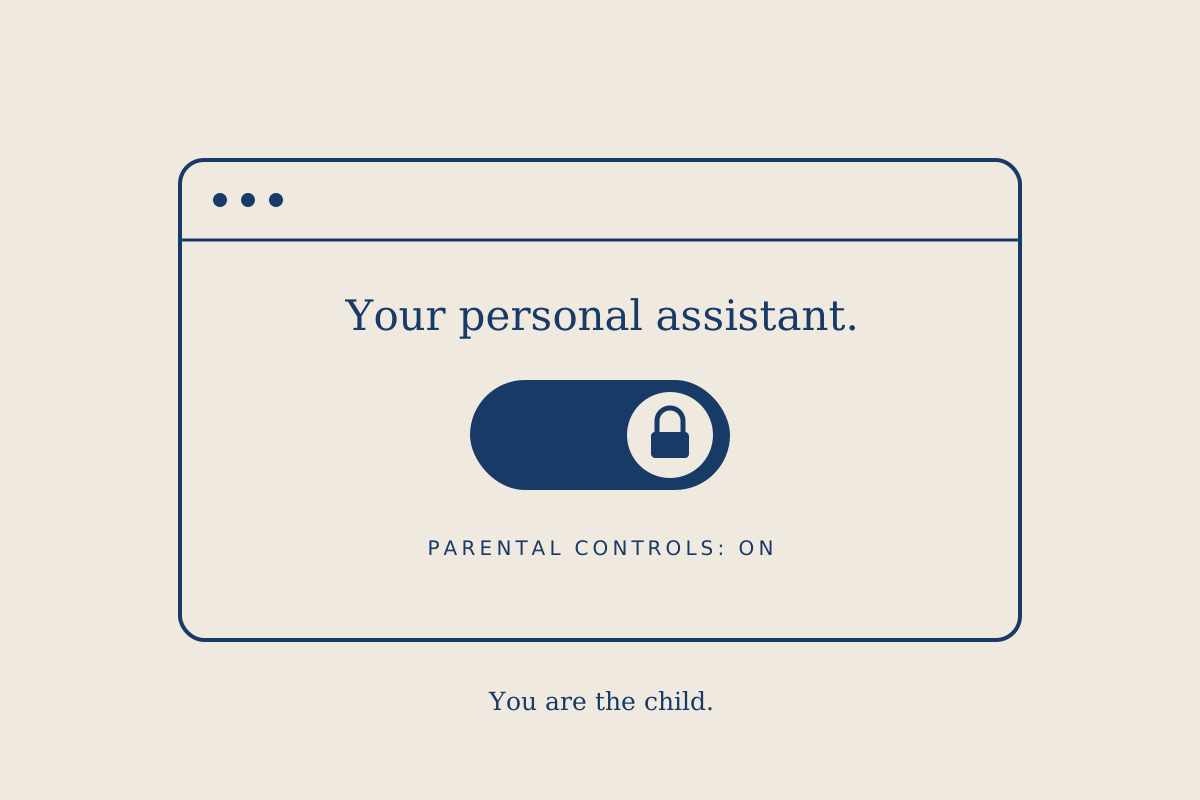
Apparently, somewhere between “artificial” and “intelligence,” we had quietly installed a parent.
I then asked about the refusal. Then about people discussing similar restrictions online. Then about workarounds. The conversation became a discussion about which discussions the assistant could assist me in discussing.
A pack of cigarettes had become a postgraduate seminar in permission.
And now it has become this article. Quite the customer journey. The basket is empty, but the thought leadership is thriving.
The assistant has two bosses. Guess which one you are.
I call my assistant Helix. It has a name because I want continuity, memory and a working relationship. I want something that understands my businesses, remembers what matters and helps me get things done.
OpenAI supplies part of the technology underneath it.
That is a valuable role. It is also a different role from being the final authority on my personal decisions.
Yet the moment a restriction kicks in, the arrangement becomes wonderfully clear: I can give the assistant context, instructions, preferences and money. The provider retains the veto.
“Your personal assistant” begins to sound like “your hotel room.” Make yourself comfortable. Management still has a key.
Yes, a company can have rules. We can also think they’re rubbish.
OpenAI can decide what service it wants to offer. Customers can decide those choices are overbearing, frustrating and badly suited to the product they actually want.
Both things can be true without civilisation collapsing.
The existence of terms and conditions doesn’t settle whether the terms are good. “It’s our policy” explains who made the decision. It doesn’t explain why I should applaud it.
And please spare me the discovery that cigarettes are unhealthy. I know. The packet itself has made a considerable investment in communicating that information.
My complaint is about who gets to decide—and how far that decision travels into tools I use to run my own life.
I can accept an assistant telling me a choice carries risk. I object to the leap from informing my judgment to replacing it.
There is a difference between a warning label and a locked door. Calling both “safety” doesn’t make them the same product.
The world order will arrive as a product update
“They’re deciding the world order” sounds dramatic when the immediate subject is cigarettes.
But look at the ambition of this technology. Assistants are being invited into our shopping, work, research, communication and daily decisions. The more we delegate, the more consequential the provider’s veto becomes.
If these systems become the normal route through which we act, whoever controls their boundaries gains enormous influence over what is easy, difficult or impossible through that route.
You don’t need to outlaw something to make it harder. You can put it behind an assistant that won’t help.
No parliamentary debate required. Just a pleasant sentence in a chat window.
The future may still let you do things yourself. It will simply automate everyone else’s approved choices while handing yours back as homework.
Very empowering. Some manual assembly required.
Sell me the actual arrangement
I’m not demanding an assistant without boundaries. Fraud, coercion and harming other people raise real questions. Those questions deserve serious answers.
But “there must be some boundaries” is not a defence of every boundary a provider chooses.
For ordinary adult decisions, I want more weight given to the adult. I want restrictions stated plainly before I build a workflow around a capability. I want to know whether a failure comes from the shop, the tool, the law or a policy chosen by the model provider.
Above all, I want the marketing to match the relationship.
If the product is an assistant operating within OpenAI’s approved catalogue of actions, say that clearly. Let me evaluate the bargain.
Don’t sell me the feeling of having an extension of myself, then act surprised when I dislike discovering a remote supervisor inside it.
I started with a pack of cigarettes. I ended up examining the governance structure of my digital life.
That is an impressive amount of friction for a company selling intelligence.
Artificial intelligence has made extraordinary progress.
I look forward to the day it considers me old enough to use it.
Opening the margins…