
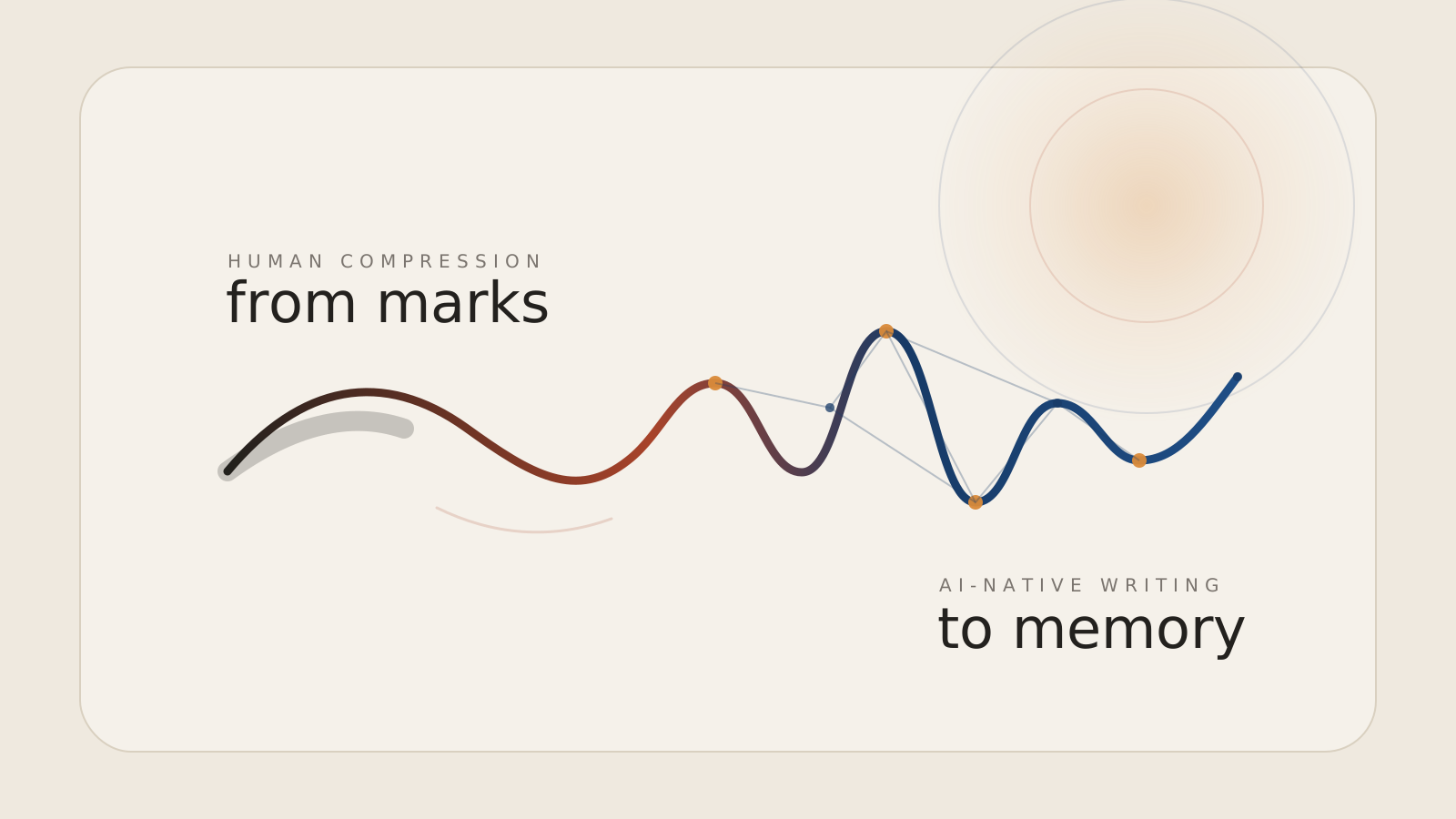
There is an old kind of magic in shorthand. A person listens to a room moving at the speed of speech and turns it into marks small enough for the hand to keep up. The page does not look like ordinary writing. It looks compressed, coded, almost secret. But its purpose is deeply practical: do not lose the living sentence while it is still alive.
For a long time, shorthand was one of the great human interfaces. Before laptops, before live captions, before automatic transcription, it was a way to narrow the gap between thought, speech, and record. It accepted a simple constraint: the human hand is slower than the human voice. Then it designed around that constraint.
What shorthand really solved
Shorthand was not just faster handwriting. It was a compression system for language. It removed what could be inferred, abbreviated what repeated, and gave common sounds their own elegant symbols. The stenographer was not merely copying words. They were translating a fast, messy human stream into a form that could survive the moment.
That distinction matters now because the bottleneck has returned in a new shape. Many people can think faster than they type. They can explain an idea on a walk, in a car, between meetings, or into a phone at midnight — but the formal act of writing still asks them to sit down, open a document, and perform linear clarity before the idea has even settled.
Speech-to-text is the visible layer. AI is the new expansion layer.
Speech-to-text changed the first half of the equation. Dictation lets language enter the machine at nearly conversational speed. A voice note can become text in seconds. A rambling explanation can become a transcript. The hand is no longer the gatekeeper.
But transcription alone is not enough. Raw speech is usually not writing. It loops, hesitates, repeats, contradicts itself, and points at things the listener already knows. This is where AI-native writing becomes interesting. AI can expand the shorthand. It can identify the argument inside the ramble, preserve the original texture, separate signal from throat-clearing, and turn a spoken fragment into a draft, memo, outline, brief, or publishable essay.
Old shorthand compressed speech so a person could record it. Modern shorthand captures speech so a system can help us think with it.
Voice is becoming an interface for thought
The phrase “text-to-speech” often gets used as shorthand for the broader voice interface era, but the writing revolution here is mostly the other direction: speech-to-text, voice dictation, and conversational capture. We speak into machines; machines return structure.
That shift is not merely convenient. It changes where ideas are born. Writing no longer has to begin as typing. It can begin as a walk, a conversation with an agent, a private voice memo, or a rough spoken sketch. The first artifact is not a polished paragraph. It is a captured field of intent.
From typing bottleneck to thinking loop
When typing is the main interface, the writer must hold the idea, compose the sentence, operate the keyboard, and edit the result all at once. The mind becomes both author and machine operator. Some beautiful work comes from that friction. But friction also filters out a huge amount of thought before it can be seen.
Modern shorthand changes the loop:
- Capture first: speak the idea before it disappears.
- Transcribe quickly: convert voice into text without ceremony.
- Structure with AI: ask the system to find themes, claims, questions, and missing pieces.
- Edit with taste: bring judgment, rhythm, accuracy, and voice back into the draft.
The human is still responsible for meaning. The machine is responsible for reducing the operational drag between thought and material.
Why this matters for memory
Captured thought becomes searchable. Searchable thought becomes reusable. Reusable thought becomes a kind of external memory. This may be the deeper change: modern shorthand does not only help us write faster; it helps ideas remain available after the moment has passed.
A stenographer’s notebook preserved what happened in a room. An AI-native writing system can preserve what happened in a mind: the unfinished metaphor, the half-formed strategy, the emotional emphasis in a voice note, the fragment that would never have survived the blank page.
What modern shorthand is not
It is not a license to publish unexamined output. It is not a replacement for taste. It is not the end of careful writing. If anything, it makes editing more important, because the volume of captured language increases.
The best use of AI in writing is not to flatten every voice into the same competent paragraph. It is to protect the fragile beginning of an idea long enough for a human to shape it well.
The new literacy
The next writing skill may look less like typing speed and more like capture discipline: knowing when to speak, how to prompt memory, how to ask an AI system for structure without surrendering judgment, and how to edit the result until it sounds inevitable.
Shorthand taught us that tools for writing are also tools for attention. They decide what gets preserved. They decide what becomes searchable, shareable, and remembered. Voice and AI are giving us another such tool — softer than the keyboard, closer to thought, and powerful enough to change the first moment of writing itself.
Modern shorthand, defined simply
What is modern shorthand?
Modern shorthand is a workflow where voice dictation, speech-to-text, and AI help capture spoken or rough thoughts and convert them into structured writing.
How is it different from traditional shorthand?
Traditional shorthand compressed speech into symbols for human recording. Modern shorthand captures voice as text, then uses AI to organize, refine, and retrieve the idea.
Is this about text-to-speech or speech-to-text?
The core writing shift is speech-to-text: turning spoken thought into text. Text-to-speech belongs to the same voice interface era, but modern shorthand is primarily about dictation, transcription, and AI-assisted writing.
Opening the margins…