
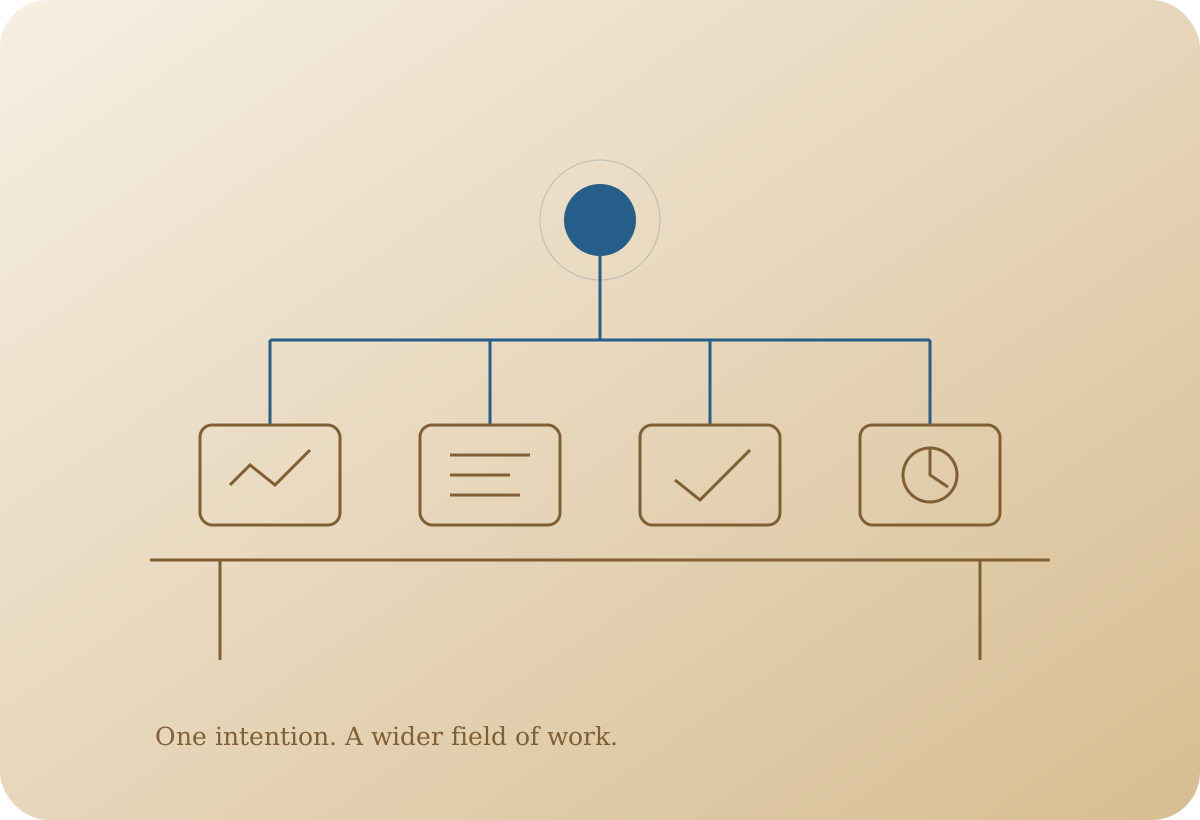
I think one of the most consequential job descriptions of the coming years will be a simple one: manager of agents.
A person responsible for an outcome, working with a collection of agents that research, prepare, execute and check different parts of the work.
My expectation is that AI-first organisations will move towards a smaller set of horizontal managers with a much broader field of action. Work that once travelled through several departments could be carried from question to verified result by a manager and the systems around them.
This is a direction I believe in, not a claim that hierarchy has already disappeared. Some organisations will retain deep specialist structures, and some work will remain intensely human. But I expect fewer layers to be necessary simply to move information and coordinate execution.
The change will arrive unevenly. It is useful to imagine it in three stages: near term, mid term and long term. These are stages of capability and organisational trust, rather than dates on a calendar.
Near term: learning to delegate precisely
At first, the manager of agents may look like a capable individual contributor with an unusually broad toolkit.
They will still do much of the framing and review themselves. An agent might investigate a question, another prepare a draft, and a familiar software workflow handle a predictable calculation.
Consider a hypothetical customer-account problem. Someone reports that they cannot access a service. An agent can be assigned to check the account state and recent changes, then propose a remedy.
The brief needs to be precise. Which records can it inspect? Can it change anything? What would count as a successful resolution? When should it stop and return to the manager?
A report saying “I reset access” would need supporting evidence. The manager should be able to distinguish the customer’s request, the permission to act, the attempted change and the verified account state.
The beginnings of this technical pattern already exist. Anthropic has described a research system in which a lead agent divides a question among other agents and combines their findings. The same account describes coordination difficulties and the need for clear task boundaries. That is evidence of a working software architecture in a particular setting, rather than evidence that a whole company can be organised the same way. How we built our multi-agent research system.
In this near-term stage, I would expect much of the manager’s value to come from making ambiguous intentions executable. A good brief would carry the objective, the relevant context, the limits of authority and the evidence required at the end.
Writing that brief is management work.
Mid term: managing horizontally
The more interesting change begins when agents can operate across the tools that divide a business into departments.
Imagine an inventory discrepancy. A stock report says an item is missing. A spreadsheet suggests it was received. A message says a shipment was delayed.
In a hypothetical agent-enabled operation, the person responsible for resolving the discrepancy could commission several bounded investigations: reconcile the records, establish the shipment timeline and inspect the affected customer commitments. The manager would bring the findings together and decide what to do.
An important discovery might be that the reports refer to different cut-off times. Correcting that interpretation could settle the discrepancy without changing any stock record.
This is what I mean by horizontal management: enough reach across functions to resolve a complete problem. A manager follows the outcome through the organisation, with agents doing much of the gathering and execution along the way.
My prediction is that this could reduce the need for layers whose primary role is passing tasks onward and collecting status updates. Domain expertise would still matter. So would knowing when a question needs a specialist rather than another automated pass.
It would also require a shared account of the work. If an agent discovers that the shipment date is wrong, the correction must reach every task that depends on it. The organisation needs to preserve what was requested, what was authorised, what changed and which evidence supports the conclusion.
A larger number of agents alone would not produce this structure. The connections between them have to be designed.
The span of control has a new limit
It is tempting to describe this future by counting how many agents one manager can supervise. I think that misses the constraint.
The span of management will be limited by what a person can verify and remain accountable for.
If every completed task demands a long investigation, the human becomes a queue through which all the work must pass. If the manager accepts every result without inspection, apparent scale can conceal repeated errors.
I would build the work so that ordinary cases carry compact evidence, exceptions arrive with the decision clearly stated, and actions with serious consequences have an explicit human checkpoint. A manager should be able to inspect the original record behind a conclusion without reconstructing an entire conversation.
Adding another checking agent would be useful only when the check adds something real. A second system repeating the same unsupported assumption would offer little reassurance. A reconciliation against the source records or a test of the changed system would be more informative.
There are also practical limits to parallel work. In its research-system account, Anthropic reports increased resource use and explains that tasks with many interdependencies are a poor fit for that architecture. Its broader engineering guidance recommends adding complexity only when outcomes justify it. Research-system lessons, building effective agents.
A good manager of agents should therefore be comfortable choosing a single agent, a fixed workflow or a human conversation when that is the better way to finish the job.
Long term: deciding what deserves to happen
If agents become more reliable at planning, coordination and verification, I expect people to delegate more of the management process itself.
An agent might identify dependencies, commission missing research, revise a plan after a failure and return with a tested result. The human would have less reason to allocate every small task by hand.
The work I would reserve for human leadership in that organisation is setting purpose and taking responsibility for trade-offs. Which customer promise should we make? Which opportunity is worth pursuing? What level of uncertainty is acceptable? When should we stop a technically successful project because it is solving the wrong problem?
These questions involve consequences for people and commitments the organisation must stand behind. I would want a named person answerable for them, even when agents supply the analysis.
The long-term organisation I imagine has a relatively small number of people carrying broad responsibilities, supported by many adaptable agents. Some of those people may be deep specialists. Others may be unusually good at bringing several disciplines together. Their authority would need to be clear even if the reporting structure becomes flatter.
This is not a forecast of a particular headcount or a promise that every company will converge on the same design. It is an argument that the shape of an organisation should change when the cost and mechanics of coordination change.
How someone learns this job
There is a connection here to the future of internships.
If a company expects people to arrive ready to supervise systems across a broad area, it must provide a way to develop that judgment. Giving a beginner a collection of agents and a large responsibility would be a poor substitute for teaching.
I would start with a bounded outcome, visible source material and a mentor who reviews the reasoning. Responsibility could expand as the person demonstrates that they can recognise uncertainty, catch errors and finish the work.
The portfolio that matters would show decisions defended, failures understood and processes improved. The number of agents used would be incidental.
A broader field of responsibility
I expect the manager of agents to become an important role because AI could let a person act across a much wider area of a business.
That possibility is exciting. A clear intention could travel further before it is diluted by handoffs. A small team could investigate more carefully and complete work that previously required a larger coordination structure.
Realising it will require patient design: clear authority, reliable tools, inspectable outcomes and people with the knowledge to question what they receive.
The organisations that do this well could have fewer layers and more room for initiative. They will still need someone who understands the purpose of the work, notices when it is drifting and is willing to own what happens next.
Continue reading: Internships are dead.
Opening the margins…