
The strange thing about agents is that they arrived with real ability before the world had made any room for them. They can reason through a workflow, read the screen, press the button, draft the reply, reconcile the table, call the tool, and try again when the first attempt fails. In many narrow moments, this already feels like the future.
Then the future meets a login form designed for a hurried human. A captcha expires. A bank session times out. A mobile app hides the relevant action behind a gesture. A CRM changes the label on a button. A trading terminal requires confidence faster than the model can earn it. The agent is not weak exactly. It is operating inside a world that never expected it to exist.
This is why the agent utopia is not here yet. Not because the models are useless. Not because automation is a fantasy. But because the present internet, present enterprise stack, and present device ecosystem are overwhelmingly human-shaped.
We are asking agents to inhabit human machinery
Most of the systems where economic work happens were designed around a person sitting in front of a screen. The interface assumes eyes, hands, memory, improvisation, and a tolerance for ambiguity. It assumes the operator can notice when the page feels wrong. It assumes the operator can call someone, wait, refresh, inspect a PDF, interpret a vague error, and decide whether to continue.
Agents can imitate some of this. They can parse visual hierarchy. They can click. They can retry. They can call APIs when APIs exist. But imitation is not the same as belonging. A browser automation running through a banking portal is often a machine pretending to be a person so another machine will allow the work to proceed.
Agent utopia will not be a robot clicking through our old software faster. It will be a new contract between work, systems, and human judgment.
The adaptation era
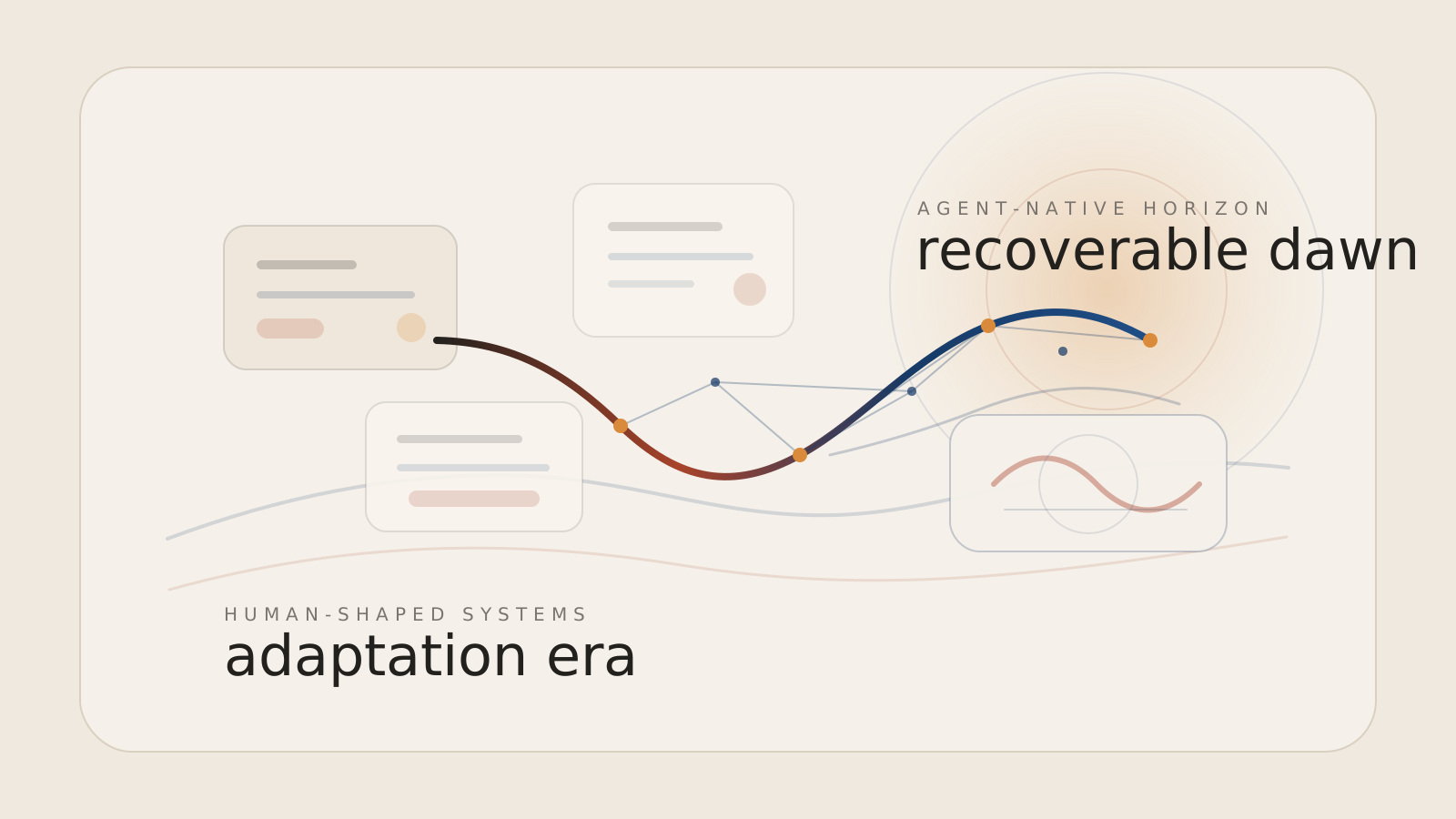
We are living in the adaptation era: strong agents, weak habitat. The models are becoming capable enough to attempt real operations, but the surrounding world still punishes them for not being human in exactly the right way.
This era is useful. It teaches where the friction is. Every brittle workflow is a diagnostic. Every failed automation tells us which assumption was smuggled into the product: that the user can see the alert, that the session will survive, that the button text is stable, that no one needs an audit trail, that failure can be handled by a confused human at the end of the line.
The temptation is to solve all of this with cleverness: better prompts, more screenshots, more retry logic, more browser control, more hidden state. Some of that is necessary. But cleverness alone turns into maintenance. It makes the agent more acrobatic without making the environment more hospitable.
Agent-native interfaces
The next layer is agent-native interface design. Not merely APIs, though APIs matter. Not merely chat boxes, though conversation matters. Agent-native means a system exposes its actions, constraints, state, permissions, and failure modes in a way a machine can understand without pretending to be a human user.
An agent-native banking flow would not force a model to infer whether a transfer succeeded from a toast notification. It would return a durable transaction object, a confidence state, a reversible window where appropriate, and a clear escalation path. An agent-native CRM would not hide business meaning behind fragile layout. It would make intent, records, dependencies, and side effects explicit.
Good human interfaces reduce cognitive load. Good agent-native interfaces reduce operational ambiguity. The best products will do both.
Recoverability is the heart of trust
People often ask whether agents can be trusted. The more precise question is whether the system around the agent is recoverable. Can we see what happened? Can we pause before irreversible actions? Can we roll back? Can we hand off to a human at the right moment? Can we distinguish an inconvenience from a dangerous uncertainty?
Recoverability is what turns automation from a magic trick into infrastructure. It is the difference between “the agent did something” and “the agent attempted this action, under these permissions, with this evidence, and stopped here because judgment was required.”
The agent itself is only one part of the trust surface. The rest is product architecture: logs, approvals, sandboxes, retries, typed actions, scoped credentials, memory, observability, and graceful degradation. Utopia requires not only intelligence, but repair.
Human-agent-native products
The phrase agent-native can sound like humans disappear. That is the wrong direction. The better frame is human-agent-native: products designed for a new division of labor where people provide taste, goals, ethics, context, and final responsibility; machines provide patience, recall, execution, comparison, and operational reach.
In a human-native product, the person does the work and the software assists. In an agent-native product, the agent can do the work and the software exposes the machinery. In a human-agent-native product, the system understands when each should lead.
This is a subtle design problem. Too much autonomy and the product becomes unnerving. Too much approval and the agent becomes a decorative intern. The art is in finding the right checkpoints: where the machine should move freely, where it should ask, where it should stop, and where the human should never have to spend attention again.
The real utopia is quieter
The popular image of agent utopia is theatrical: fleets of tireless workers operating every system on our behalf. The more interesting version is quieter. Fewer tabs. Fewer broken handoffs. Fewer forgotten follow-ups. Less operational residue left on the human mind.
When the habitat is ready, agents will not feel like hacks crawling across old surfaces. They will feel like a natural layer of work. A person will state intent. The system will know what can be done, what should be confirmed, what evidence is needed, and how to recover when reality refuses the plan.
That future is close enough to glimpse and far enough to require discipline. The models will improve. But the deeper work is to rebuild the world around them: interfaces that machines can inhabit honestly, systems that fail safely, and products that respect the human role instead of pretending to erase it.
The agent utopia is not here yet. We are in the era before it — the era of adaptation, translation, and difficult learning. That is not a disappointment. It is the construction phase.
Opening the margins…